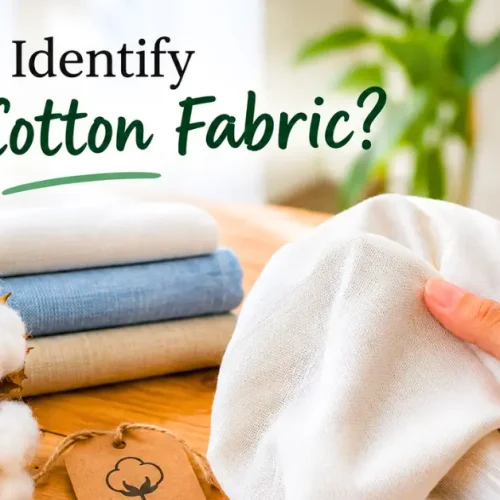
You found a shirt tagged “100% cotton.” It feels a little too smooth, there’s a faint shine, and the price looks off. Fair doubt.
Here’s how to identify pure cotton fabric fast: read the care label, check how it wrinkles, drop water on it and burn one loose thread if you can spare it. Pure cotton creases, soaks up water and burns like paper. Blends often don’t.
Below are seven tests, ranked by how much I trust them, plus a clear call on which pieces are worth buying in pure cotton.
Read the Label First, Then Question It
The care label is your fastest check. Look for a fiber line that reads 100% cotton, with no polyester, elastane or viscose after it. If the label is missing, cut out, or says only “cotton blend,” move to the hands-on tests below.
- Check the sewn-in tag at the neck or side seam. Hang tags are marketing. Sewn labels carry the fiber content.
- Read the whole line. “98% cotton, 2% elastane” is common in jeans and chinos. It’s not a trick, just not pure.
- Shopping online? Open the product details and find the composition field. If it’s missing, treat that as a warning.
- I treat a label as strong evidence, never as proof. Mistakes and mislabeling happen.
No label, or you don’t trust it? Time to use your hands.
How to Tell If Fabric Is 100% Cotton Without a Label
No label? Work through the tests from safest to riskiest: touch, squeeze, water drop, stretch, thread check, then last option is burn. One test never proves anything. When two or three agree, you can be fairly confident, and all six agreeing is about as sure as home testing gets.
Test 2: Feel and look
- Do: Rub the fabric between your fingers. Look at it in daylight.
- Pure cotton: Matte, slightly dry, cool on first touch. A little fuzz at the seams.
- Blend or synthetic: Smooth, slick or silky. Sometimes a faint shine.
- Catch: Softener finishes and brushed cotton can feel slick or fleecy. This is a hint only.
Test 3: The squeeze test
- Do: Crush a handful in your fist for 10 seconds, then let go.
- Pure cotton: Holds deep creases.
- Blend or synthetic: Springs back with few wrinkles.
- Catch: Easy-iron finishes make real cotton resist creasing. So a clean result means little, but deep creases mean a lot.
Test 4: The water drop test
- Do: Put one drop of water on an inside area. Watch for 10 seconds.
- Pure cotton: Soaks in fast and the dark spot spreads.
- Blend or synthetic: The drop beads up or sinks in slowly.
- Catch: New fabric often carries sizing, and water-repellent finishes block even cotton. This is the weakest test on the list.
Test 5: The stretch test
- Do: Pull a small patch gently, then release it.
- Woven cotton (shirts, chinos): Barely moves.
- Knit cotton (tees): Stretches, then recovers slowly and may sag a bit.
- Fast snap-back: Elastane is in the mix.
- Catch: Stretch cotton is comfortable. It’s just not pure.
Test 6: The thread untwist
- Do: Pull a loose thread from a hem. Untwist it with your nails and look closely, with a magnifier or your phone camera zoom.
- Pure cotton: Short, fuzzy fibers with uneven thickness.
- Polyester filament: Long, smooth, glassy strands.
- Catch: Spun polyester can look fuzzy too. Also, the stitching thread is often polyester even on cotton garments, so pull a thread from the fabric itself, not the seam.
Test 7: The burn test (careful with this one)
- Safety first: Burn only a loose thread or a snippet about an inch long (2 to 3 cm), never the garment. Hold it with tweezers over a sink, with water nearby and nothing flammable around. Keep kids away.
- Pure cotton: Catches fast, burns with a steady yellow flame, smells like burning paper, leaves soft grey ash.
- Polyester or nylon: Shrinks from the flame, melts, leaves a hard bead, smells chemical.
- Blend: A mix of both. Paper smell, then a small hard bead at the edge.
- Catch: It can’t give you a percentage. Linen and viscose burn like cotton too, and some finishes change the smell.
Seven tests, seven different answers? Here’s the cheat sheet.
Pure Cotton Test Results at a Glance
Use this table as a cheat sheet in a store or at home for how to identify pure cotton fabric?. Read each row across: what pure cotton does, what blends and synthetics do, and how much weight the test deserves. Treat “weak hint” results as a nudge, never as a verdict.
| Test | Pure cotton | Blend or synthetic | How much to trust it |
| 1. Label | Says 100% cotton, sewn in | Lists polyester, elastane or viscose | Strong, not proof |
| 2. Feel and look | Matte, dry, cool | Slick, smooth, slight shine | Weak hint |
| 3. Squeeze | Deep creases stay | Springs back | Medium |
| 4. Water drop | Absorbed in seconds | Beads or sits on top | Weak hint |
| 5. Stretch | Little give, slow recovery | Fast snap-back | Medium |
| 6. Thread untwist | Short, fuzzy fibers | Long, smooth strands | Medium to strong |
| 7. Burn | Yellow flame, paper smell, grey ash | Melts, hard bead, chemical smell | Strongest at home |
How to Identify Pure Cotton Fabric When Tests Disagree
Trust the burn test on a loose thread first, the label second, and the thread untwist third. Treat the feel and squeeze tests as hints, and the water drop as the weakest. When results clash, a finish is usually the reason, so wash the fabric once and test again.
Here’s my ranking, best to worst:
- Burn test: the clearest split between cotton and polyester.
- Label: honest most of the time, but check it against a physical test.
- Thread untwist: reliable once you know what fuzzy versus glassy looks like.
- Stretch test: the best way to catch hidden elastane.
- Squeeze test: fooled by easy-iron finishes.
- Feel and look: fooled by softeners.
- Water drop: fooled by sizing and repellent coatings.
Quick tip: My rule: label plus one physical test. If the label says cotton and the burn test agrees, I stop there.
Cotton, Linen, Viscose or Polyester? Telling Look-Alikes Apart
Cotton, linen and viscose burn almost the same, so fire can’t separate them. Use touch and sight instead. Linen is crisp with thick-and-thin slubs, viscose is slippery and drapes heavy, polyester is smooth and slightly shiny. Cotton sits in the middle: matte, soft and even.
- Linen: Uneven, slubby yarn. Crisp feel. Wrinkles hard. Burns faster than cotton.
- Viscose (rayon): Slippery, drapey, a little heavy. Feels weak when wet.
- Polyester: Smooth, sometimes shiny, warm and slick. Melts in the burn test.
- Polycotton: The UK term for a cotton-polyester blend. It reads like cotton in the hand and like polyester in the burn.
Can an App or a Photo Identify Fabric Online?
Not reliably. A photo can’t show fiber content online, because two fabrics can look identical and still be different fibers. I wouldn’t trust any app to confirm 100% cotton. Check the label and run the hands-on tests. A lab fiber test is the only real proof.
Buying in bulk or reselling? Pay for a textile lab test. For one shirt, the tests above are enough.
Cotton Buying Mistakes to Avoid
The biggest mistake is judging cotton by softness alone. Softeners and brushing can make blends feel gentle and real cotton feel slick. Other traps include trusting “cotton feel” wording, testing a coated sample, and washing hot on day one. Here are five to avoid.
- Judging by softness. Softness is a finish, not a fiber.
- Believing “cotton feel,” “cotton touch” or “cotton-rich.” None of them means 100%.
- Testing the stitching thread. It’s often polyester. Test the fabric yarn.
- Water-testing brand-new fabric. Sizing and repellent finishes give false readings.
- Hot-washing pure cotton on day one. It can shrink. Wash cool and check the care label first.
FAQs
1. How can I tell if fabric is 100% cotton?
Check the sewn-in label first. Then run the squeeze, thread and burn tests. Cotton holds creases, shows short fuzzy fibers, burns with a yellow flame and paper smell, and leaves soft grey ash. Two or three agreeing results is a solid sign.
2. Which is better, 100% cotton or polyester?
It depends on the job. Cotton breathes and feels softer on skin. Polyester dries faster, resists wrinkles and often costs less. Pick cotton for hot weather and daily wear. Pick polyester or a blend for the gym, travel and rain.
3. Is there an app that identifies fabric online?
Nothing I’d trust for fiber content. A photo can’t show what a fiber is made of. Use the label and hands-on tests, or a lab test if you need proof.
4. What type of cotton is the highest quality?
Long-staple cottons like Sea Island, Egyptian and Pima are usually ranked highest, because longer fibers make smoother, stronger yarn. Weave and finishing still matter.
5. What is another name for cotton?
Cotton has no true synonym. People call it a natural fiber, or name it by weave: poplin, twill, jersey, denim, oxford.
Quick Recap
Read the label, squeeze the fabric, check one thread, and burn a loose strand if you must. Two tests that agree beat one test you like. Buy pure cotton for tees and shirts, and let chinos have a little stretch.
Want more wardrobe basics like this? Browse the fabric and outfit guides on Vastra Soul.